This longer reference provides the background behind the topic. Read it alongside the recipe collection when you want to connect an ingredient or food idea with a dish to prepare.
In this story
OverviewNameDescriptionDistribution and habitatPhylogenyBreeding and selection programsUsesOverview
The pecan (Carya illinoinensis) is a species of hickory native to the Southern United States and northern Mexico in the region of the Mississippi River.
Originally native to the south-central U.S., the tree is cultivated for its seed primarily in the U.S. states of Georgia, New Mexico, Texas, Louisiana and in Mexico. The seed is an edible nut used as a snack and in various recipes, such as praline candy and pecan pie. The pecan is the state nut of Alabama, Arkansas, California, Texas, and Louisiana, and is also the state tree of Texas.
Name
The word "" derives from the Algonquian languages variously referring to pecans, walnuts, and hickory nuts. There are many pronunciations, some regional and others not. There is little agreement in the United States regarding the "correct" pronunciation, even regionally.
In 1927, the National Pecan Growers Association acknowledged variant pronunciations while designating one as official and correct: "pronounced as though spelled pea-con ... those in the habit of using any other pronunciation therefore be requested henceforth to adopt exclusively the pronunciation above specified above and hereby adopted by the Association."
Description
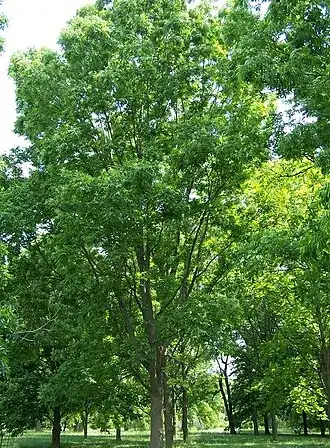
The pecan tree is a large deciduous tree, growing to 20 - 40 m in height, rarely to 44 m. It typically has a spread of 12 - 23 m with a trunk up to 2 m diameter. A 10-year-old sapling grown in optimal conditions will stand about 5 m tall. The leaves are alternate, 30 - 45 cm long, and pinnate with 9–17 leaflets, each leaflet 5 - 12 cm long and 2 - 6 cm broad.
A pecan, like the fruit of all other members of the hickory genus, is not truly a nut, but is technically a drupe, a fruit with a single stone or pit, surrounded by a husk. The husks are produced from the exocarp tissue of the flower, while the part known as the nut develops from the endocarp and contains the seed. The husk itself is aeneous, that is, brassy greenish-gold in color, oval to oblong in shape, 2.6 - 6 cm long, and 1.5 - 3 cm broad. The outer husk is 3 - 4 mm thick, starts out green, and turns brown at maturity, at which time it splits off in four sections to release the thin-shelled seed.
Distribution and habitat
Pecan trees are native to the south-central U.S., but have spread due to cultivation.
C. illinoinensis is found in bottomlands, suburban woodlands, disturbed areas, and along forest edges; it commonly naturalizes near where cultivated trees are located. C. illinoinensis grows on soils that are not subject to frequent flooding, preferring moist, well-drained, rich soils.
Phylogeny
The first fossil examples of Juglandaceae appear during the Cretaceous. Differentiation between the subfamilies of Engelhardioideae and Juglandioideae occurred during the early Paleogene, about 64 million years ago. Extant examples of Engelhardioideae are generally tropical and evergreen, while those of Juglandioideae are deciduous and found in more temperate zones.
The second major step in the development of pecan was a change from wind-dispersed fruits to animal dispersion. This dispersal strategy coincides with developing a husk around the fruit and a drastic change in the relative concentrations of fatty acids. The ratio of oleic to linoleic acids is inverted between wind- and animal-dispersed seeds. Further differentiation from other species of Juglandaceae occurred about 44 million years ago during the Eocene. The fruits of the pecan genus Carya differ from those of the walnut genus Juglans only in the formation of the husk of the fruit. The husks of walnuts develop from the bracts, bracteoles and sepals, or sepals only. The husks of pecans develop from the bracts and the bracteoles only.
Breeding and selection programs
Active breeding and selection is carried out by the USDA Agricultural Research Service with growing locations at Brownwood and College Station, Texas. University of Georgia has a breeding program at the Tifton campus working on selecting pecan varieties adapted to subtropical Southeastern U.S. growing conditions.
While selection work has been done since the late 19th century, most acreage of pecans grown today is of older cultivars, such as 'Stuart', 'Schley', 'Elliott', and 'Desirable', with known flaws, but also with known production potential. Cultivars such as 'Elliot' are increasing in popularity due to resistance to pecan scab. The long cycle time for pecan trees plus financial considerations dictate that new varieties go through an extensive vetting process before being widely planted. Numerous varieties produce well in Texas, but fail in the Southeastern U.S. due to increased disease pressure. Selection programs are ongoing at the state level, with Alabama, Arkansas, Florida, Georgia, Kansas, Missouri, New Mexico, and others having trial plantings.
Varieties adapted from the southern tier of states north through some parts of Iowa and even into southern Canada are available from nurseries. Production potential drops significantly when planted further north than Tennessee. Most breeding efforts for northern-adapted varieties have not been on a large enough scale to significantly affect production. Varieties that are available and adapted (e.g., 'Major', 'Martzahn', 'Witte', 'Greenriver', 'Mullahy', and 'Posey') in zones 6 and farther north are almost entirely selections from wild stands. 'Kanza', a northern-adapted release from the USDA breeding program, is a grafted pecan having high productivity and quality, and cold tolerance.
Uses
Pecan seeds are edible, with a rich, buttery flavor. They can be eaten fresh or roasted, or used in cooking, particularly in sweet desserts, such as pecan pie, a traditional Southern U.S. dish. Butter pecan is also a common flavor in cookies, cakes, and ice creams. Pecans are a significant ingredient in American praline candy. Other applications of cooking with pecans include pecan oil and pecan butter.
Pecan wood is used in making furniture and wood flooring, as well as flavoring fuel for smoking meats, giving grilled foods a sweet and nutty flavor stronger than many fruit woods.
More to savor

Chicken Vindaloo
Grilled Cheese Sandwich II
Potato in the Kitchen: Exploring an Everyday Ingredient